Preachers and their preaching – Henry Ward Beecher
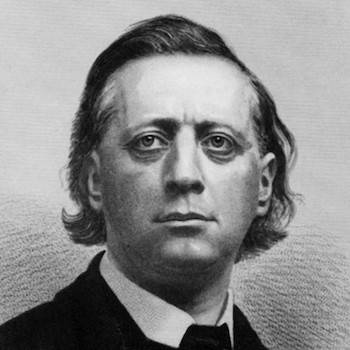
Henry Ward Beecher (1813-1887) was one of the most popular and influential preachers of his day.
He was son of Lyman Beecher, popularizer of the ‘New School’ theology which sought to soften the Calvinism of New England. Henry went still further in this rebellion, emphasising an emotional and ethical faith.
Duduit notes:
‘Where the father stressed God’s power and justice, the son came to emphasize God’s love and mercy.’
Beecher:
‘advocated women’s rights, opposed slavery, championed social reform, defended evotion, supported higher biblical criticism, and popularized romantic Christianity.’ (David McCarthy)
Ultimately (notes Duduit)
‘such an expansion of the pulpit’s role in the political arena laid one portion of a foundation for the activists who came to be identified with the term “Social Gospel” in the late nineteenth and early twentieth centuries.’
Beecher emphasised heart and action over mind and doctrine. Duduit notes:
‘Beecher believed strongly that most people could be best reached through an appeal to their emotions. In the Yale lectures, he suggested that six would be touched by such an appeal for every one that was motivated by reason.53 Crocker observed that Beecher would have agreed with Cicero’s observation in De oratore that humankind make far more determinations through hatred, or love, or desire, or anger, or grief, or joy, or hope, or fear, or error, or some other affection of mind, than from regard to truth, or any settled maxim, or principle of right, or judicial form or adherence to laws.’
His preaching method was influenced by his reading of the preaching of the apostles in the Book of Acts. He observed that they often began with commonly accepted beliefs (‘You all knows’), and he compiled a list fo forty such assumptions.
In 1847 Beecher became the first pastor of Brooklyn’s Congregational Church, and he spent the rest of life there.
McCarthy notes:
‘Widely praised as a popular and powerful preacher and lecturer, Beecher rarely preached from a full manuscript during his later years. His pockets were often full of small scraps of paper covered with random jottings and flashes of insight, and he kept a small notebook of illustrations and sermon ideas not yet “ripened”. On Sunday mornings, Beecher retired to his study for an hour after breakfast, when he chose a ripe sermon topic, selected a text, and made a sketchy one-page outline before going to church. Even after the service began, he might change his sermo topic and text before he stood up to preach.’
‘He preferred a loosely connected sermon form, often stringing together a series of illustrations, which he called “windows in an argument”.’
Beecher used illustrations freely. Duduit notes:
‘Beecher believed they helped people understand abstract ideas more clearly, were an aid to memory, stimulated the imagination, provided a mental release for the audience, helped to communicate a single truth to a varied audience, and enabled the minister to subtly introduce controversial topics.’
Beecher believed that in the ethical thrust of his preaching he was following the Lord Jesus.
‘The business of the church, therefore, was not primarily to prepare people for an afterlife, but to “build up men in the qualities of Jesus Christ,” and it was toward that goal that preachers should aim.’ (Duduit)
From 1871, Beecher gave the first three annual Lyman Beecher lectures. These, and his sermons, were held in high esteem by teachers of rhetoric and homiletics long after his death.
Duduit comments:
‘Theologically, Beecher proceeded to abandon more and more orthodox Calvinist doctrine. He had always tried to avoid eternal damnation as a sermon topic; he soon abandoned it entirely. He once remarked of Edwards’s sermon “Sinners in the Hands of an Angry God” that “a person of moral sensibility alone at midnight, reading that awful discourse, would well nigh go crazy.”27 In two 1849 articles on conversion, Beecher further departed from orthodoxy by stressing that this radical religious change was accomplished in accordance with natural law. God produces results through the natural functioning of the human mind, not in spite of human capability.28 Beecher came to believe that people must make a free choice for or against God—no notion of election or predestination—and a person is left with “the same faculties, intellectual, moral, social, and animal, before conversion as after.”29 Beecher had an optimistic view of human nature, even in connection with a theology of conversion, gradually adopting a belief in human perfectibility, in contrast to the Calvinist doctrine of total depravity.’
It is difficult to avoid the conclusion that Beecher came to believe in a God fashioned after our own image, rather than the reverse. So, rather oddly, he urged that for God to seek his own gloy would be just as wrong in God as it would be in us:
‘When, therefore, men . . . have taught us that God lives for his own glory, how many hearts have turned away! Not even the fear of being lost could compel them to worship a Supreme Being who sat seeking that which he utterly forbids us to seek—his own selfish glory. To teach that God has a right to do as he pleases—unless he pleases to do benevolently—is to teach a view of God which cannot but offend the moral understanding.’ (Quoted by Duduit)
David B. McCarthy, in Concise Encyclopedia of Preaching, art. ‘Beecher, Henry Ward’
Michael Duduit, in A Legacy of Preaching, Vol 2.