Preachers and their preaching – J.A. Broadus
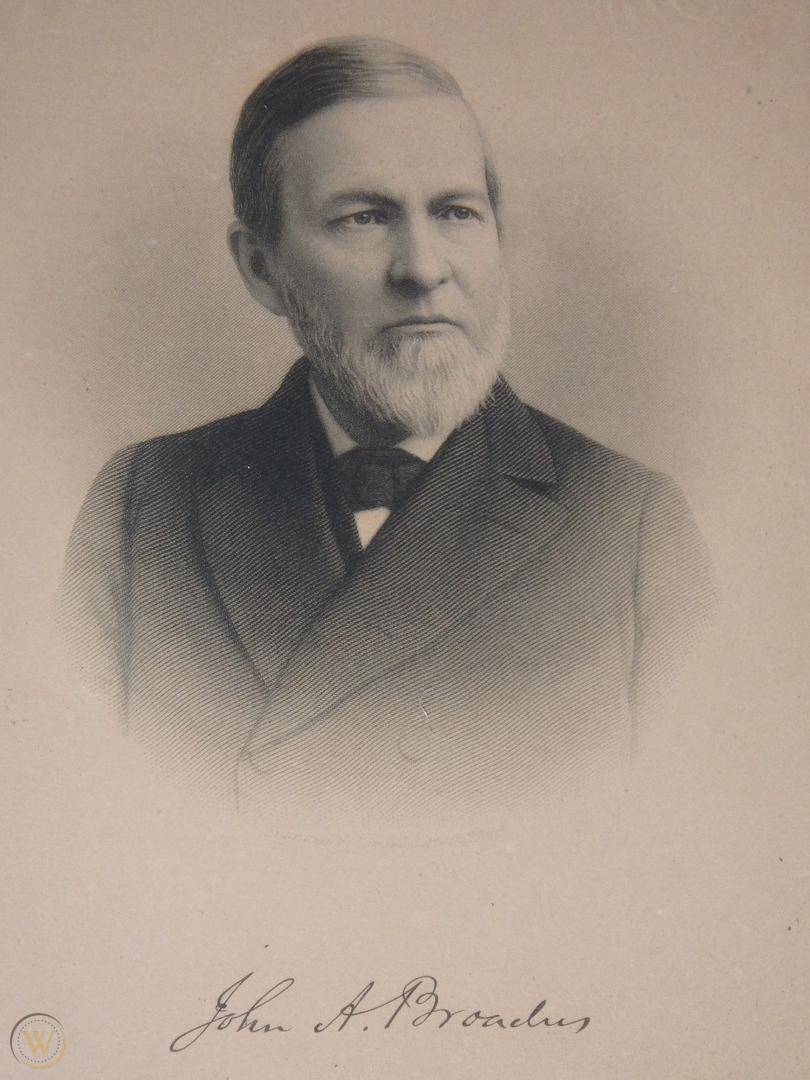
John Albert Broadus (1827-1895) was both a celebrated preacher and a teacher of preaching. His Treatise on the Preparation and Delivery of Sermons was for decades the most widely-used and influential manual on preaching.
Hershael York claims:
‘Nearly everything written on expository preaching is derivative of Broadus’s Treatise to some extent, often massively so.’
Broadus espoused, in the face of incipient modernism and liberalism, theological orthodoxy allied to a firm belief in the infallibility of the Bible.
He maintained that preaching must be rooted in the biblical text, and must be grounded in sound exegesis.
He wrote:
‘To interpret and apply his text in accordance with its real meaning is one of the preacher’s most sacred duties.’
He made extensive use of secular theories of rhetoric, logic and persuasion – especially those of Cicero and Quintilian.
But eloquence, for Broadus was not an end in itself, but a means to persuasion. Quoting Broadus himself, York writes:
‘”Eloquence is so speaking as not merely to convince the judgment, kindle the imagination, and move the feelings, but to give a powerful impulse to the will.” In other words, eloquence was not measured by the beauty of the rhetorical display, but by its ability to lead the listener to act.’
As York notes, Broadus stressed the importance of effective delivery, addressing aspects such as energy, style, passion and voice production.
Broadus promoted extemporaneous delivery:
‘The preacher must trust their preparation and entrust themself to God by preparing a sketch of the sermon, leaving it at home, and preaching with freedom. . . . The most gifted of preachers engaged themselves, if not at first, in the practice of free delivery.’
Broadus insisted that application was critical importance to the sermon:
‘The application in a sermon is not merely an appendage to the discussion, or a subordinate part of it, but is the main thing to be done.’
Critique
While Broadus emphasised the importance of determining the meaning of the biblical text, his method is open to the criticism that he pays too little to the wider context of the chosen text, or to the overall storyline of the Bible. His lack of interest in the story told in any of the Gospels, or in the flow of argument in, say, the Epistle to the Romans, is a weakness shared with many of his contemporaries.
We might add that this weakness, which includes the habitual selection of just one or two verses as a text, sometimes leads to the use of the text as a general statement of truth rather than as a specific step in a story or argument. For example, a sermon on ‘The Habit of Thankfulness‘ (text: 1 Thess 5:18) ignores Paul’s context and consequently does not ask why this injunction might have been needed by these particular people, at this particular time (with the possibility of then making more specific connections to contemporary people and their situations).
Whereas the criticism of Demetrius Rogers that Broadus’ preaching was strong on doctrine and duty, but lacked appropriate emphasis on grace seems, on examination of sample sermons, to be only partly true, the claim lack of awareness of what has come to be called ‘Biblical Theology’ (the unfolding revelation of God’s redemptive purposes in Christ) does hold, just as it holds for many other preachers of the day.
York observes:
‘Oddly enough, Broadus never argued for a systematic series of sermons through books or large passages. This is perhaps the greatest omission and weakness of the Treatise. He spends a great deal of space writing about the selection of a text, but never advocates simply expounding biblical truth in the same manner that one encounters it, line upon line and precept upon precept.’
Bibliography
Hershael York, ‘John Albert Broadus: Carefully Expositing the Authoritative Scriptures’ in A Legacy of Preaching: Apostles to the Present Day. Zondervan Academic.
Demetrius Rogers, ‘The Preaching of John Broadus in the Light of Biblical Theology’ Part 1, Part 2.